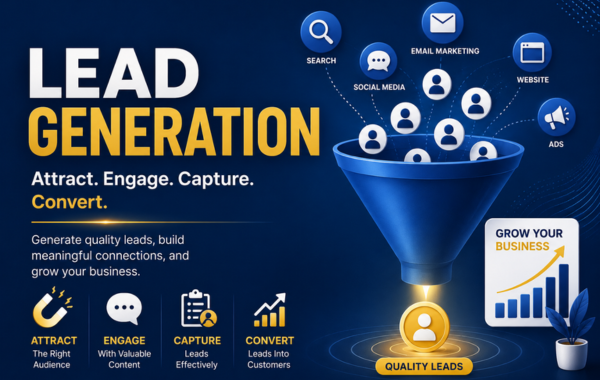
What Is Lead Generation?
In digital marketing, attracting potential customers is one of the most important steps toward business growth. However, simply getting people to visit a website or social media page does not guarantee sales. Businesses need a way to identify people who are genuinely interested in their products or services and move them toward becoming customers. This process is known as lead generation.
Lead generation helps businesses attract potential buyers, collect relevant information, build relationships, and create opportunities for future sales.
What Is Lead Generation?
Lead generation is the process of attracting and identifying people who may be interested in a business’s products or services.
A person becomes a lead when they take an action that indicates interest in a business. For example, someone may fill out a contact form, subscribe to an email newsletter, request a quotation, download an ebook, or contact the business through social media.
The main objective is not simply to collect as many leads as possible but to attract relevant and high-quality prospects who have a genuine possibility of becoming customers.
How Does Lead Generation Work?
Lead generation generally follows a simple process:
Reach → Connect → Generate Leads → Build Trust → Drive Conversions
First, businesses attract potential customers through marketing channels such as search engines, social media, advertising, websites, and content marketing.
Next, they engage visitors with useful information, offers, or solutions. When visitors show interest, businesses encourage them to provide information such as their name, email address, or phone number.
The business can then nurture these prospects through follow-up communication until they are ready to make a purchase.
Why Is Lead Generation Important?
Lead generation is an important part of digital marketing because it creates a connection between marketing activities and potential sales.
1. Helps Find Potential Customers
Lead generation allows businesses to identify people who have already shown interest in what they offer.
2. Supports Business Growth
A consistent flow of qualified leads can create more opportunities for sales and help businesses grow over time.
3. Builds Customer Relationships
Not every visitor is ready to purchase immediately. Lead generation gives businesses an opportunity to stay connected with potential customers and gradually build trust.
4. Improves Marketing Efficiency
Businesses can analyze where their leads are coming from and determine which marketing channels are producing better results.
5. Creates More Sales Opportunities
When qualified prospects are properly nurtured, they have a greater chance of moving through the sales process and becoming paying customers.
Common Lead Generation Strategies
Businesses can use a variety of digital marketing methods to generate leads.
Search Engine Optimization (SEO)
SEO helps businesses appear in search results when people are looking for products, services, or information related to their industry. Useful website content can attract visitors who already have an interest in a particular solution.
Content Marketing
Blog posts, guides, ebooks, videos, case studies, and other useful resources can attract potential customers. Businesses can offer valuable content in exchange for contact information when appropriate.
Social platforms provide opportunities to connect with potential customers through educational posts, videos, advertisements, polls, live sessions, and direct communication.
Paid Advertising
Search ads and social media campaigns can help businesses reach specific audiences. Dedicated landing pages can then encourage visitors to submit their details or take another desired action.
Email Marketing
Email campaigns help businesses stay connected with existing leads. Helpful information, product updates, offers, and personalized communication can encourage prospects to move closer to making a purchase.
Landing Pages
A landing page is designed around a specific marketing objective, such as requesting a consultation, downloading a resource, registering for an event, or submitting an inquiry.
A clear headline, relevant information, strong call-to-action, and simple form can improve the chances of converting visitors into leads.
What Is a Lead Magnet?
A lead magnet is a useful resource or offer provided to potential customers in exchange for their contact information.
Examples include:
- Free ebooks
- Checklists
- Templates
- Industry reports
- Webinars
- Free consultations
- Product demonstrations
- Educational guides
- Free trials
The best lead magnets solve a specific problem or provide useful information to the target audience.
Types of Leads
Not every lead has the same level of interest or readiness to buy.
Marketing Qualified Lead
A Marketing Qualified Lead (MQL) has shown meaningful interest through marketing activities but may not yet be ready to speak with a sales representative.
Sales Qualified Lead
A Sales Qualified Lead (SQL) is a prospect who has demonstrated stronger buying intent and may be ready for direct sales communication.
Cold Lead
A cold lead has limited interaction with the business and may require additional communication before showing serious interest.
Warm Lead
A warm lead has interacted with the business and demonstrated some level of interest.
Hot Lead
A hot lead shows strong purchase intent and may be close to making a buying decision.
Lead Generation Funnel
Lead generation is often connected to the marketing and sales funnel.
At the awareness stage, people discover a business or its content. During the interest and consideration stages, they learn more about the available solutions.
As their interest increases, they may submit an inquiry, request pricing, schedule a consultation, or take another action that identifies them as a lead.
The final objective is to convert qualified prospects into customers.
How to Generate High-Quality Leads
Getting a large number of leads does not always mean a campaign is successful. Businesses should focus on attracting prospects who are relevant to their products or services.
Some effective practices include:
- Clearly defining the target audience
- Creating useful and relevant content
- Using specific landing pages
- Offering valuable lead magnets
- Writing clear calls-to-action
- Making forms simple and easy to complete
- Following up quickly
- Personalizing communication
- Tracking campaign performance
- Regularly improving marketing strategies
- Common Lead Generation Mistakes
Businesses can lose valuable opportunities by making avoidable mistakes.
Targeting Everyone
Trying to reach everyone can make marketing messages too general. Defining a specific target audience usually creates more relevant campaigns.
Using Weak Calls-to-ActionVisitors need tounderstand what they should do next. A clear call-to-action can make the next step easier.
Asking for Too Much Information
Long forms can discourage visitors from completing them. Businesses should generally request only the information they actually need at that stage.
Ignoring Follow-Ups
Generating a lead is only the beginning. Without timely and relevant follow-up, interested prospects may lose interest or choose another business.
Focusing Only on Quantity
A large number of low-quality leads may provide less business value than a smaller group of highly relevant prospects.
How to Measure Lead Generation Success
Businesses can use several metrics to evaluate their lead generation efforts.
Important measurements include:
Number of leads generated
Cost per lead
Lead conversion rate
Landing page conversion rate
Marketing qualified leads
Sales qualified leads
Customer acquisition cost
Lead-to-customer conversion rate
Return on marketing investment
Tracking these metrics helps businesses understand which strategies are producing meaningful results.
The Role of AI in Lead Generation
Artificial intelligence is increasingly being used to improve lead generation. AI-powered tools can help businesses analyze customer behavior, identify promising prospects, personalize communication, automate follow-ups, and improve campaign targeting.
However, technology works best when combined with a clear strategy, useful content, and a strong understanding of the target audience.
Conclusion
Lead generation is a fundamental part of modern digital marketing. It helps businesses attract interested prospects, collect valuable information, develop relationships, and create opportunities for sales.
A successful lead generation strategy is not simply about collecting contact details. It is about attracting the right audience, providing genuine value, building trust, and guiding potential customers toward a purchase decision.
By combining SEO, content marketing, social media, paid advertising, landing pages, email marketing, and effective follow-up, businesses can build a consistent system for generating and converting high-quality leads.